






From Demand to AI Evolution: A Practical Guide to Integrating Software and Hardware Product Development
In the second half of the mobile internet era, companies expect far more from "digital products" than a simple information page. They want systems that genuinely solve business problems — apps, mini programs, and even integrated hardware-software smart products. What steps does it take to develop a product? Why do some products end up unusable? And in the AI era, is it too late to get started? This article answers these questions in one place: from the full development workflow and pitfalls to avoid, to how to transform and grow in the age of AI — giving you a complete and clear picture of product development.
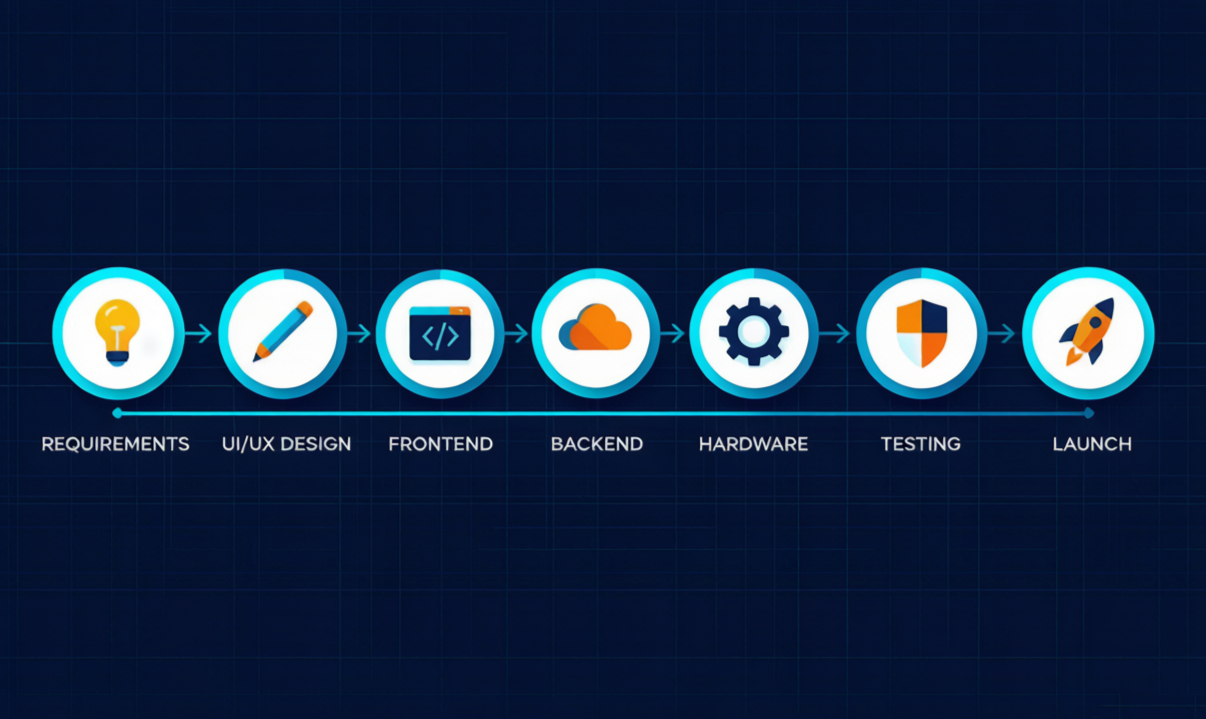
I. The Full Development Workflow: Seven Steps from Idea to Launch
1. Requirements Analysis and Product Definition
Every development effort begins with requirements. The core of this stage is turning an "idea" into an "executable plan": Who are the target users? What problem are we solving? What are the core features? Which features belong in the first phase? We recommend producing a clear requirements document and a feature list with priorities (P0/P1/P2) to avoid the chaos of "trying to do everything."
The time invested at this stage determines 80% of the rework that follows. The clearer the requirements, the less rework later.
2. UI/UX Design and Interactive Prototypes
Product experience is what keeps users coming back. Designers produce page flow diagrams, high-fidelity prototypes, and visual design specs that define information architecture, user journeys, and visual style. Good design isn't "pretty" — it lets users "know how to use it without thinking." Once the prototype is approved, communication costs between design and development drop significantly, and flow issues surface early.
3. Frontend Development: The Differences Between Apps and Mini Programs
For native apps, the technology path depends on the platform: iOS native, Android native, or cross-platform frameworks like Flutter and React Native. Native development delivers the best performance and most refined experience; cross-platform development is more efficient, reusing one codebase across two platforms, though it involves trade-offs in complex interactions and hardware capability access.
Mini programs, meanwhile, rely on ecosystems like WeChat. They have a low development threshold, low distribution cost, and are "use-and-go" — ideal for lightweight businesses and private-domain traffic operations. However, they are subject to platform rules, and the platform defines the feature boundaries. The right choice depends on the product form, team capability, and budget.
4. Backend and Cloud Architecture
Behind the interface users see lies the "brain" that supports the business: servers, databases, APIs, push notifications, file storage, and more. The development team must design a sound system architecture that ensures stability under high concurrency and data security, while leaving room for elastic scaling — whether the system can scale smoothly as the business grows directly determines the product's ceiling.
5. Hardware Development and Hardware-Software Integration (for Integrated Projects)
If the product includes smart hardware (such as smart strollers, unmanned devices, or smart terminals), deep coordination between hardware and software is essential: embedded firmware development, communication protocol design, data collection, and cloud synchronization. Hardware-software integration is the stage that most tests a team's engineering skill — network fluctuations, device variance, and power management all require repeated testing and refinement. A failure at any point directly affects the user experience.
6. Testing and Launch
Once feature development is complete, testing begins: functional testing, compatibility testing, performance testing, and security testing — none can be skipped. After passing, the product is submitted for review to the app store or mini program platform. Review is the "first hurdle" many teams hit — incomplete materials, policy violations, or missing privacy disclosures can all lead to rejection. Understanding platform guidelines in advance saves a great deal of rework.
7. Operations, Maintenance, and Iteration After Launch
Launch is not the finish line; it is the starting point. Products need continuous monitoring, user feedback collection, and data instrumentation, refined through version iterations. A mature product often goes through dozens of versions before delivering a stable, smooth user experience. The ability to keep iterating is the product's true moat.
II. Pitfalls to Avoid: Sidestepping These Traps Saves Months of Detours
1. Starting Development with Unclear Requirements Is the Most Expensive Mistake
Without a clear requirements document, constantly "adding requirements" mid-development is the leading cause of delays and budget overruns. We recommend starting with an MVP (Minimum Viable Product), validating core value first, then expanding gradually — spending limited resources on the most critical features.
2. Technology Selection Should "Match," Not "Follow Trends"
New technology is not necessarily good technology. Cross-platform frameworks save cost, but they may struggle with complex animations or deep hardware interactions. Building your own servers offers flexibility, but cloud services (such as Tencent Cloud and Alibaba Cloud) are more cost-effective and easier to maintain. The only selection criterion is whether the technology fits your business scenario and team capability.
3. Hardware-Software Coordination: Don't Underestimate the Complexity of "Connection"
In integrated products, communication stability between hardware and app, the timeliness of data synchronization, and reconnection mechanisms after abnormal disconnects are the lifeline of user experience. Define communication protocols and exception-handling logic early in the project — don't wait until the integration phase to patch things up, when rework costs have already multiplied.
4. Start Security and Compliance on Day One
With regulations such as the Personal Information Protection Law and the Data Security Law now in force, data compliance is no longer optional. Privacy policies, user consent, data encryption, filing and review materials — all of these must be designed into the requirements stage. Fixing them just before launch risks delays at best and app removal at worst.
5. Performance and Experience Determine Retention
Slow startup, laggy interactions, and endless loading on weak networks are the top three reasons users uninstall products. Performance metrics (such as first-screen time, response speed, and crash rate) must be hard acceptance criteria during development, not "good enough" afterthoughts.
6. Documentation and Code Standards Are the Foundation of Long-Term Thinking
Team turnover is the norm. Solid documentation, disciplined code, and a clear project structure let newcomers take over quickly and prevent the product from becoming a "black box nobody dares to touch." This investment yields no visible return in the short term, but its long-term value is enormous.
7. Budget and Scheduling: Leave Room for the Unexpected
In software development, "unplanned things" are the norm: API changes, design adjustments, review rejections, ad-hoc requests. We recommend reserving 15–20% buffer in both schedule and budget, and setting review gates at key milestones (prototype sign-off, hardware-software integration, pre-launch) so risks surface early rather than erupting at the last moment. Transparent, honest scheduling communication is also the foundation of long-term trust between client and vendor.
III. The AI Era: From "Building a Product" to "Building a System That Evolves"
If the past decade of software development was about "efficiency," the next decade will be about "intelligence." AI is reshaping the software industry on three levels — and opening entirely new possibilities for integrated hardware-software products.
1. AI Transforms the Development Paradigm: Faster Code, Lower Cost
AI-assisted programming tools (code completion, auto-generation, intelligent testing) have dramatically improved development efficiency, and low-code/no-code platforms let non-technical people build basic applications. For SMEs, the digitalization that once seemed "unthinkable" is now within reach. But note: AI accelerates speed, not judgment — generated code still needs human review, and security and architecture decisions must be made by people.
2. AI Capabilities Built into Products: From "Usable" to "Understanding You"
Intelligent customer service, voice interaction, image recognition, personalized recommendations — AI is becoming the standard capability of products. The spread of large language models and generative AI has further lowered the barrier to intelligent features: devices can converse with users in natural language, systems can automatically generate content and reports, and customer service can respond to complex inquiries 24/7. In hardware-software products, for example: cameras with AI vision can detect anomalies and proactively alert; sensor data with machine learning can predict equipment failures and enable preventive maintenance; user behavior data with recommendation algorithms can deliver tailored services to each individual. These capabilities evolve products from "passive response" to "proactive service."
3. Data-Driven Iteration: Products Get Smarter with Use
AI's value is built on data. Through instrumentation and data analysis, companies can understand real user behavior; through continuous model training and feedback loops, products keep improving the experience. In the future, the differentiator is not who has more features, but who has deeper data assets and faster iteration loops — and this is precisely the natural advantage of integrated hardware-software products: hardware collects data, software analyzes it, AI drives decisions, forming a complete value flywheel.
4. The Long-Term Path for Enterprises: Staying Competitive in the AI Era
Facing the AI wave, enterprises should focus on three things:
- Treat AI as a "product capability," not a "marketing gimmick" — implement it from real business scenarios, not AI for AI's sake;
- Build a data foundation — without data, AI is water without a source; data collection, governance, and security systems should be established early;
- Maintain organizational agility — let technology and business teams evolve together, build fast experiment-and-validate mechanisms, and stay ahead in the technology race.
IV. Conclusion: Technology Changes, but the Essence of Creating Value Does Not
From requirements analysis to AI transformation, software development methodologies evolve, but the underlying logic remains the same: great products always come from deep understanding of user needs, solid engineering capability, and a keen grasp of technology trends. In the AI era, tools are upgrading and barriers are falling, but the thinking behind "what to build, why to build it, and who to build it for" will always be the rarest capability of all.
Whether you are planning your first product or considering the intelligent upgrade of an existing one, we welcome you to talk with us — let us use technology to turn your ideas into products that truly create value.
Published by the [Siring] technology team, specializing in app, mini program, and integrated hardware-software development services.








 Call
Call