






# Resonance of AI, Cloud and Data: Six Definitive Directions for Corporate Technology Strategy in 2026
2026-08-13 17:32:14
As technological evolution enters an era of integrated explosion, dividends from isolated breakthroughs are narrowing, while compound interest effects from cross-technology synergy are emerging. For corporate decision-makers, the core agenda for 2025–2026 is no longer “whether to embrace new technologies”, but “how to generate multiplicative effects through technology portfolios”.
I. Large AI Models Enter Deep Waters: From General Intelligence to Enterprise Productivity
In 2025, the large model industry completed a pivotal shift from a “parameter race” to an “implementation race”. Although the growth curve of model capabilities has flattened, application penetration is accelerating. This means corporate competitiveness hinges no longer on access to the most cutting-edge models, but on the ability to embed model capabilities into real business workflows.
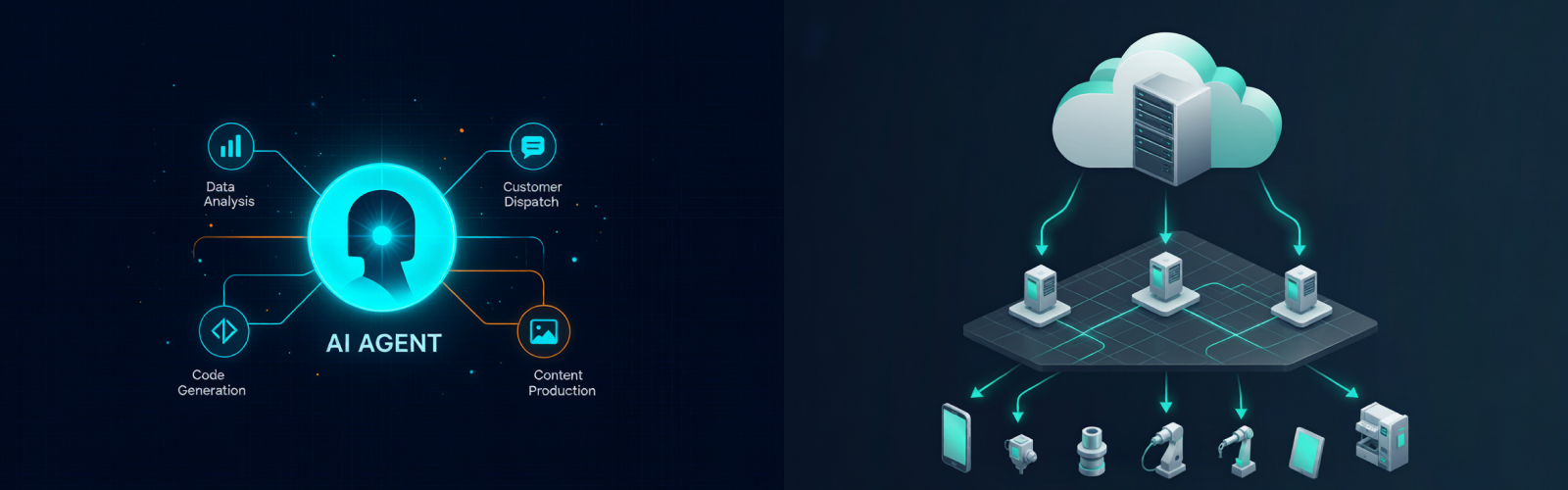
Agents represent the most promising frontier in this phase. Unlike single-turn question-and-answer interactions, Agents can decompose objectives, call external tools, conduct multi-step reasoning and execute tasks autonomously. They take over complex workflows previously requiring manual orchestration. From intelligent customer service and code generation, bulk marketing content production to supply chain scheduling optimization, Agents are elevating AI from auxiliary tools to digital employees.
Three key observations for enterprises:
First, scenario granularity determines ROI. Standardized processes with sufficient accumulated data deliver the most dramatic efficiency gains from Agents.
Second, private and lightweight deployment has become a rigid requirement. Enterprises prefer running vertical models in controlled environments to balance performance and data security.
Third, human-machine collaboration, rather than full machine replacement, is the optimal short-term solution. AI handles repetitive, rule-based work, while humans focus on judgment and creative decision-making.
First, scenario granularity determines ROI. Standardized processes with sufficient accumulated data deliver the most dramatic efficiency gains from Agents.
Second, private and lightweight deployment has become a rigid requirement. Enterprises prefer running vertical models in controlled environments to balance performance and data security.
Third, human-machine collaboration, rather than full machine replacement, is the optimal short-term solution. AI handles repetitive, rule-based work, while humans focus on judgment and creative decision-making.
Trend Outlook: In 2026, a wave of AI-Native applications will emerge in volume. Instead of retrofitting AI features onto existing products, these solutions will be redesigned from the ground up with AI as the core interaction logic.
II. Cloud Computing & Cloud-Native: From Cloud Migration to Cloud Optimization
Over the past decade, enterprises solved the problem of resource migration to the cloud. In the next two years, the industry will focus on architectural cloud utilization. Beyond foundational building blocks such as containers and microservices, cloud-native technologies are expanding comprehensively into Serverless, edge computing, and multi/hybrid cloud governance.
Serverless is redefining the boundaries of operations and maintenance. Developers are freed from managing server scaling and elastic policies, and only pay for actual code execution. This architecture fits perfectly for internet businesses with volatile traffic and high iteration frequency, abstracting infrastructure complexity so teams can fully concentrate on core business development.
The rise of edge computing is highly coupled with local AI inference demands. Where low-latency real-time reasoning is mandatory — including industrial quality inspection, autonomous driving and smart terminals — pushing computing power down to data endpoints proves more cost-effective and efficient than cloud backhaul. By 2026, the “cloud-edge-end” collaborative architecture will become the standard configuration for IoT and intelligent connected scenarios.
Meanwhile, hybrid cloud has evolved from a transitional workaround into a long-term strategic framework. Driven by cost control, regulatory compliance and data sovereignty rules, most enterprises adopt a hybrid model: core sensitive data is stored on-premises, and elastic variable workloads run on public clouds. Unified observability tools and multi-cloud governance platforms have become new competitive battlegrounds for cloud vendors.
III. Data Security & Compliance Governance: From Cost Center to Value Moat
Since data was officially recognized as a factor of production, data governance has undergone a fundamental strategic upgrade. It is no longer a back-office compliance task, but a prerequisite enabling secure data circulation, trading and monetization.
Privacy-preserving computing and trusted data spaces unlock the deadlock between data sharing and data protection. Techniques including federated learning and secure multi-party computation allow joint modeling and analytics across organizations without raw data leaving local domains. This opens compliant pathways for cross-industry and cross-enterprise data collaboration, with large-scale deployments already underway in financial risk control, medical research and smart city governance.
On the security and compliance front, systematic defense has replaced point-solution protection as the industry consensus. Zero Trust architecture has moved from theoretical concepts to practical engineering, covering full-lifecycle dynamic authentication across identities, devices, applications and datasets. New risks introduced by AI itself — such as model hallucinations, data poisoning and prompt injection — have given birth to the brand-new discipline of AI security governance. Enterprises that embed “shift-left security + continuous validation” mechanisms by 2026 will gain an upper hand in regulatory compliance and customer trust.
Core Takeaway: Whoever enables data to be used boldly, efficiently and securely will own the core asset of the industrial internet era.
IV. Deepened Industrial Internet: Digital Transformation Reaches Advanced Stages
If digital transformation in previous years centered on online migration — digitizing paper-based workflows — the keywords for 2025–2026 are intelligence and end-to-end process integration.
Traditional sectors including manufacturing, energy, agriculture and healthcare are shifting from fragmented point applications to holistic end-to-end overhauls. Industrial internet platforms keep expanding connected device fleets, and massive operational data feeds back into model training, forming a closed loop: Data → Modeling → Optimization → Reproduction. Use cases such as digital twins, predictive maintenance and flexible production have proven measurable ROI and are scaling beyond pilot projects.
Crucially, industrial internet transformation can no longer be led solely by the IT department. Trinity reform aligning business, technology and organizational structure determines success or failure. Technology addresses technical feasibility, while organizational and process restructuring decides practical adoption and outcomes.

V. Tipping Point of Technology Convergence: Integrated Resonance of AI × Cloud × Data
AI, cloud computing and data once operated as three relatively independent technological tracks. Today they are deeply integrated into a mutually reinforcing technology triangle:
- Cloud provides elastic computing power and global distribution infrastructure for large-scale AI deployment, without which mass rollout of foundation models would be impossible.
- AI empowers data with actionable insights and automated decision-making, turning dormant data assets into executable business strategies.
- High-quality data fuels continuous model training and iterative optimization, forming a feedback loop for sustained AI performance improvement.
This convergence delivers far more than productivity gains; it reconstructs underlying business models. Emerging paradigms including MaaS (Model-as-a-Service), integrated Data+AI platforms and cloud-native AI development environments drastically lower the technical barrier for enterprises to adopt cutting-edge technologies. For business leaders, the imperative is to break the siloed mindset of standalone tech procurement, manage investment through the lens of capability middle platforms, and avoid redundant spending and data fragmentation caused by stovepipe architecture.
VI. Strategic Recommendations for Enterprise Decision-Makers
Faced with overlapping trends and accelerated technological iteration, leaders must strike a balance between change and enduring fundamentals:
- Anchor investments to business value, not technological hype. Every tech initiative must clearly answer which core business pain point it resolves. Avoid blind AI or cloud deployment for vanity purposes.
- Prioritize building a robust data foundation. The ceiling of AI performance is bounded by data quality. Before rolling out large model applications, solidify frameworks for data collection, governance and labeling — the bedrock of all intelligent transformation.
- Adopt an agile test-and-scale mechanism with incremental iterations. Given the volatility of the technology maturity curve, follow a “pilot → validation → full-scale rollout” approach via minimum viable products (MVPs) to limit sunk costs and mitigate risks.
- Invest concurrently in talent and organizational capacity. The biggest bottleneck of technology implementation rarely lies in tools, but in human resources. Cultivate cross-functional talents with both business acumen and technical literacy, and restructure teams to support agile collaboration for long-term sustainable transformation.
- Embed security and compliance into underlying architecture. Build compliance and risk controls into the initial design phase rather than retrofitting safeguards afterward. This mitigates operational risks and builds long-term brand credibility and stakeholder trust.
Conclusion
The global technology industry stands at the tipping point of cross-domain technological fusion. Deep AI commercialization, full maturation of cloud-native architecture, value monetization of data factors, and in-depth industrial internet advancement do not evolve in isolation — they intersect and amplify one another.
The greatest opportunities belong to enterprises that abandon fragmented single-technology thinking and systematically build closed loops spanning technology, data and business. In an era where certainty is scarcer than uncertainty, rather than chasing fleeting market fads, focus on laying irreversible core foundations: strengthen the data backbone, build agile organizational systems, lock down security compliance guardrails, and laser-focus on tangible business value.
Technological waves will keep surging forward, but only enterprises that translate technological advantages into sustainable operational competitiveness can endure across economic and industry cycles.








 Call
Call