






Brand Expansion Drives Growth by Independent Sites
**Abstract:** As global e-commerce competition enters deep waters, more and more Chinese brands realize that to expand their business overseas, they cannot rely solely on platform traffic, but must also have their own foothold. This article will share a custom development case from zero to one, completed for an overseas independent website for a home furnishing company going global, covering requirements insights, technical solutions, functional architecture, and launch results, hoping to provide a reference for companies planning to go global.
**1. Why Independent Sites Have Become a Must-Have Amid the Wave of Going Global**
Over the past decade, Chinese companies have mainly relied on cross-border e-commerce platforms for going global. The platform has large traffic and quick user experience, but it brings practical issues such as homogeneous competition, ever-changing rules, rising traffic costs, and difficulties in brand accumulation. As platform dividends fade, the risk of "putting all your eggs in one basket" becomes increasingly apparent.
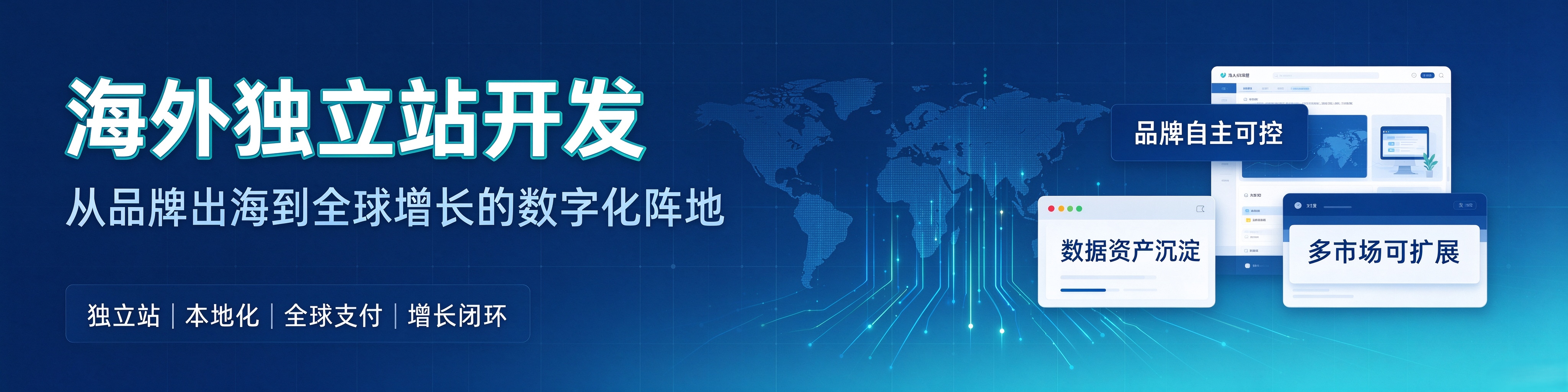
Meanwhile, overseas consumers' awareness of brands is upgrading. They no longer focus solely on "cheapness," but care more about brand story, shopping experience, and after-sales service. Against this backdrop, the Direct-to-Consumer (DTC) model has returned to center stage—companies building their own official websites, mastering data, retaining users, and setting prices independently has become a key move for more and more companies going global to build long-term competitiveness.
The value of an independent site can be summarized in three points: First, traffic and data are autonomously controllable, so every placement and every visitor can be converted into reusable assets; Second, the brand image is fully presented, conveying a unified value proposition from page design to content expression; Third, the transaction cost structure is better, which can effectively reduce platform commissions and rule dependencies in the long run.
**2. Customer Pain Points: Good Products, But Hard to Build a Good Brand**
The client in this case is a home product supplier deeply rooted in overseas markets, possessing independent R&D production capabilities and a stable supply chain, with products enjoying a good reputation in Europe and America. However, its online sales have long relied on third-party platforms, facing three major challenges:
First, **brand expression is limited**. Platform page templates are highly homogenized, failing to fully showcase product craftsmanship, brand stories, and differentiated selling points, making it difficult for clients to establish a clear brand mindset.
Second, **data asset loss**. Under the platform model, customers cannot obtain complete user profiles, repurchase behavior, and marketing attribution data, operational decisions lack basis, and membership systems are out of the question.
Third, **high traffic costs**. As platform advertising bidding becomes increasingly intense, customer acquisition costs continue to rise, profit margins are constantly squeezed, and clients urgently need a more efficient platform for traffic acquisition and conversion.
After thorough research, the client decided to build their own overseas independent site and entrusted us with full-process services from planning, design, development to launch.
**3. Customized Development Solutions: One-Time Development, Connecting Global Business**
After the project launch, we formed a dedicated team composed of project managers, UI designers, front-end engineers, back-end engineers, and overseas operations consultants, focusing on four principles: "stability, compliance, scalability, and transformation."
**1. Technical architecture: secure, stable, and scalable**
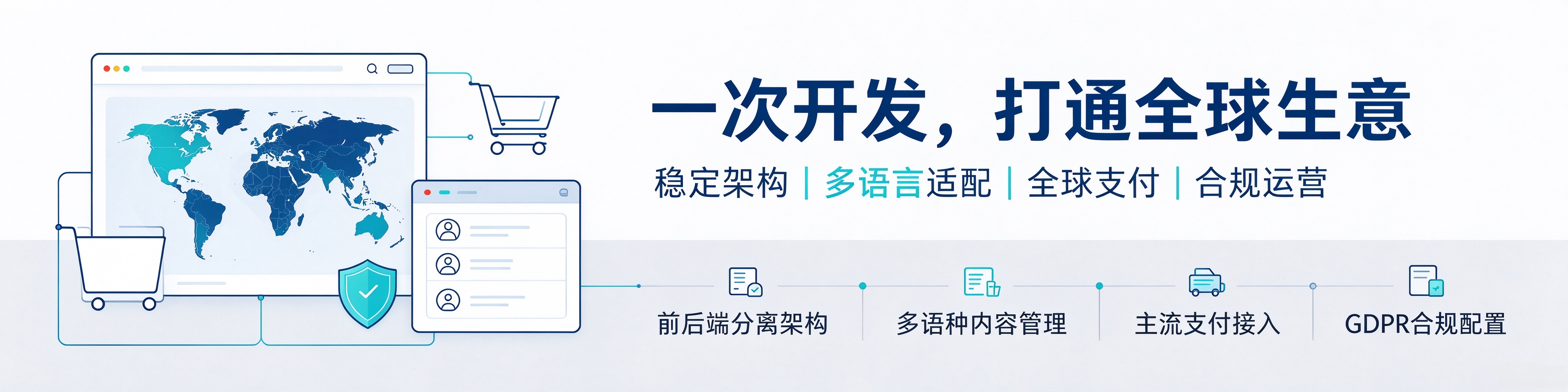
Independent sites adopt a mainstream front-end and back-end separation architecture. The frontend uses a high-performance framework to ensure page loading speed, while the backend adopts a modular design to facilitate subsequent functional expansion. HTTPS encryption and multiple security protections are enabled site-wide to ensure transaction data security. To meet the access needs of different overseas regions, we have deployed CDN global acceleration nodes to ensure smooth access in major markets such as Europe, America, and Southeast Asia.
**2. Multilingualism and Localization: Making Every Market "Speak Its Native Language"**
Going global is not simply about "translating Chinese into English." We have established a multilingual content management system for independent sites, covering all touchpoints such as product information, shopping processes, payment settlement, and customer service descriptions. We localize and adapt to target market language habits, currencies, units of measurement, date formats, and more, giving overseas users a native shopping experience.
**3. Global Payments and Compliance: Receiving Payments Without Borders**
Payment is a key link in cross-border transactions. The independent site integrates with various mainstream payment methods such as PayPal, credit cards, and local payments, covering mainstream payment habits in Europe, America, and Southeast Asia. At the same time, we assist clients in configuring overseas data compliance requirements such as GDPR, including privacy policies and cookie authorizations, to ensure the site operates legally and compliantly.
**4. Conversion-Driven Shopping Experience: Turning Traffic into Sales**
To improve conversion rates, we meticulously refined the page design: clear navigation and search, high-quality product detail pages, a smooth ordering process, trustworthy endorsement elements, and differentiated marketing components targeting both new and existing users. Fully responsive design ensures a consistently high-quality experience whether on PC or mobile.
**4. Implementation and Launch: A Complete Closed Loop from 0 to 1**
During development, we maintain high-frequency communication with clients and advance in stages: requirement confirmation and prototyping, visual and interaction design, front-end development and back-end interface co-debugging, multilingual content filling, payment and logistics integration, compatibility and performance testing. Before going live, we conducted multiple rounds of real-world testing to ensure every link was stable and reliable.
After launching the independent site, we continuously provide operational support, including SEO optimization, marketing campaign configuration, data analysis, and dashboard construction, helping clients quickly complete the positive cycle of "traffic generation — conversion — repurchase."
**5. Project Outcomes and Outlook**
After several months of operation, the client's independent site successfully achieved a breakthrough from zero to one: the site operated stably in the target market, with page loading speed and conversion experience receiving positive reviews from overseas users; Relying on on-site data analysis, customers gradually gain control over their user assets; The brand image is fully presented through customized pages, laying a solid foundation for subsequent localized marketing.
More importantly, independent sites open up greater possibilities for customers: in the future, they can refine user operations based on internal data, build membership systems, and expand into more markets and categories. Independent sites are no longer just "websites for selling goods"—they are the digital foundation for brand globalization strategies.
**Conclusion**
Going global is a long-distance race, and the independent station is the most important "home arena" for enterprises in this race. Through a professional custom development, companies not only gain a high-quality trading platform but also accumulate their own brand equity and user data. If you are also planning to build an overseas independent site, feel free to contact us and let our professional team help you grow your global business even better.








 Call
Call