






Desktop robot software and hardware research and development full-dimensional iteration, intelligent companion track ushered in the upgrade trend
2026-07-18 14:21:59
With the rapid iteration of artificial intelligence, micro-sensing, and precision machinery technology, lightweight, emotional, and intelligent desktop companion robots have rapidly emerged as a new trend in consumer smart hardware. Unlike industrial robots that focus on tool attributes and household sweeping robots with single functions, desktop robots focus on close-range human-computer interaction, intelligent companionship, and scenario-assisted services, widely applied in office assistance, home companionship, children’s education, and smart home central control. At present, the industry has formed a mature three-in-one R&D system including appearance and structural design, hardware integrated development, and software algorithm iteration. Product forms continue to improve and technologies keep upgrading, bringing broad prospects for future market development.
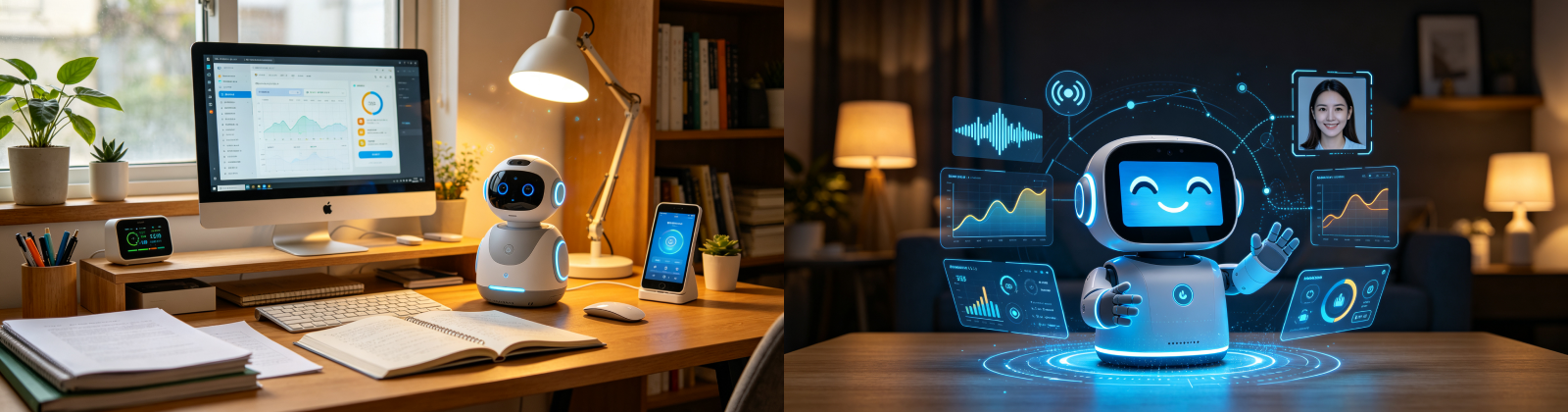
1. Appearance and Structural Design: Integration of Aesthetics and Engineering
The core goals of desktop robot design are weakening mechanical coldness, enhancing affinity, and adapting to desktop scenarios, realizing in-depth integration of industrial engineering and consumer aesthetics. In terms of modeling, the industry generally adopts rounded streamline bodies, anthropomorphic head structures, and minimalist visual language to eliminate the cold mechanical texture of traditional smart devices. Equipped with movable expression screens, rotatable heads, and fine limb adjustments, the robot gains anthropomorphic vitality and greatly improves the warmth of human-computer interaction.
The color system adapts to the mainstream minimalist style of homes and offices, dominated by low-saturation colors, with exclusive color matching for segmented scenarios such as children’s education, e-sports, and office work. High-grade consumer materials including matte ABS, skin-friendly silicone, and frosted metal are adopted to achieve fingerprint resistance, collision resistance, wear resistance and comfortable touch, improving long-term product texture.
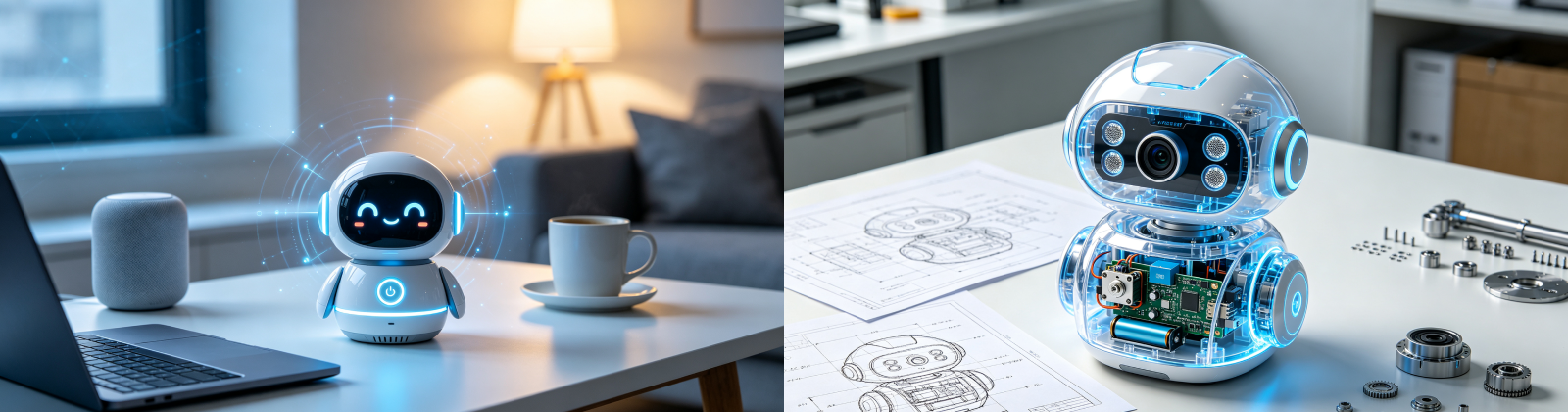
Structural engineering focuses on miniaturization, integration and high stability. Through 3D modeling and finite element simulation, the internal space layout is optimized to integrate multiple hardware components in a tiny desktop volume while reserving functional expansion space. Micro multi-degree-of-freedom servo motors form the core motion system, supporting head pitching, rotation and fine movement with silent, smooth and non-stuttering operation. Gravity center sinking and symmetric counterweight design effectively solve the problems of tilting and shaking, greatly improving desktop operation stability.
2. Hardware System Development: High-Integration Lightweight Smart Hardware Foundation
The desktop robot hardware system adopts a low-power, high-integration and high-sensing embedded architecture, consisting of four core units: main control computing unit, environment sensing unit, motion execution unit and intelligent power supply unit, which jointly support refined intelligent interaction experiences.
As the core brain of the device, the main control unit generally adopts high-performance embedded AI chips to balance computing power and power consumption, capable of running lightweight AI models such as speech recognition, visual analysis and semantic understanding locally. Mid-to-high-end models are equipped with exclusive edge AI computing chips to support offline intelligent operation, featuring faster response and higher privacy security. Standard expansion interfaces are reserved for long-term functional iteration and peripheral upgrading.
The sensing system adopts a multi-sensor fusion solution, integrating wide-angle cameras, array noise-canceling microphones, six-axis attitude sensors, infrared ranging and light sensors. The vision module realizes face recognition, gesture control, user following and scenario recognition; the audio module supports 360° directional sound pickup, intelligent noise reduction, long-distance wake-up and multi-turn dialogue; the attitude sensor corrects motion deviation in real time to ensure accurate and stable movement, building an all-round environmental sensing system.
The motion execution unit is equipped with high-precision micro servo motors, featuring low noise, fast response and high stability to support anthropomorphic micro-interactions. Mobile desktop robots adopt a micro differential drive structure for flexible steering and stable movement in narrow desktop spaces. The power supply system uses lightweight lithium polymer batteries matched with an intelligent power management system to dynamically adjust power consumption, achieving long battery life, low energy loss, intelligent sleep and low battery reminder.
3. Software Algorithm Development: Multi-Modal Anthropomorphic Interaction System
Software algorithms are the core of intelligent and emotional experiences for desktop robots. Industry software R&D focuses on multi-modal interaction, autonomous learning, scenario adaptive intelligence and cloud security collaboration, completely changing the passive command-based interaction of traditional smart devices and realizing real two-way anthropomorphic companionship.
The multi-modal interaction system covers speech, vision and touch interaction. Based on noise reduction algorithms and semantic large models, speech interaction supports natural multi-turn dialogue, intelligent Q&A and life service commands; vision interaction identifies user expressions, emotions and gestures to actively adapt to companionship, comfort and concentration modes; touch interaction supports multi-level induction feedback with simple operation and immersive interaction.
Autonomous learning algorithms enable personalized customized services for different users. The robot can memorize user habits, preferences and commonly used functions, continuously optimize interaction logic, and adapt to individual usage styles. Built-in scenario recognition models can automatically identify office, home, study and leisure scenarios to intelligently switch operation modes and adapt to environmental atmospheres.
The cloud collaboration system supports remote control, data synchronization and online OTA upgrades, enabling continuous functional updates and experience optimization without hardware replacement. A complete data encryption and privacy protection mechanism is deployed to ensure secure and controllable user interaction data.
4. Future Development Trends of the Industry
Future desktop companion robots will iterate rapidly in five major directions: edge AI intelligence, emotional anthropomorphic interaction, vertical scenario specialization, extreme hardware lightweighting, and whole-house intelligent ecology.
Technologically, lightweight edge large models will be fully popularized, enabling robots with autonomous thinking, active service and scenario prediction capabilities, upgrading from passive response to active companionship. The continuous iteration of multi-modal fusion sensing will make interaction accuracy, emotion recognition and environmental understanding close to real human interaction.
In terms of products, flexible materials, invisible mechanical structures and extreme lightweight design will become mainstream, greatly improving product safety and aesthetic texture. Modular design will support appearance replacement and functional expansion to realize personalized customization experiences.







 Call
Call